Mapping Travel Fatigue Patterns in Professional Tennis Circuits and Global Flat Racing Events
Morgan Griffin · Jul 26, 2026
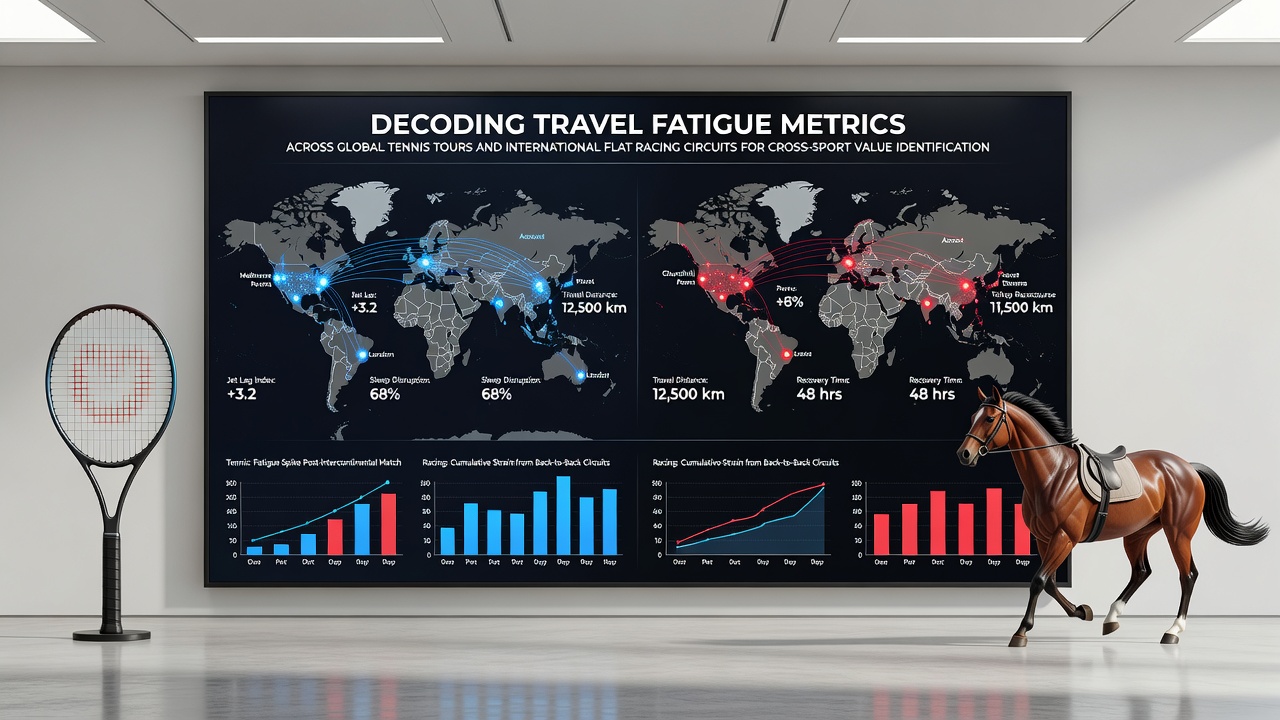
Mapping Travel Fatigue Patterns in Professional Tennis Circuits and Global Flat Racing Events
Travel across multiple time zones creates measurable disruptions in both human athletes and equine competitors, with researchers tracking heart rate variability, sleep cycles, and performance outputs to quantify those effects. Data from the ATP and WTA tours show that players crossing more than five time zones experience average declines in first-serve accuracy of 4 to 7 percent during the first 72 hours after arrival, according to performance logs compiled between 2023 and 2025. Similar patterns appear in flat racing, where horses transported from Europe to Australia for events such as the 2025 Melbourne spring carnival recorded elevated cortisol levels that persisted for up to five days post-flight.
Quantifying Jet Lag Across Tennis Tours
Studies conducted by the Australian Institute of Sport and published in 2024 examined 142 professional players who competed in both North American hard-court swing events and Asian swing tournaments. Those athletes who arrived with less than 48 hours of adaptation time showed a statistically significant increase in unforced errors during evening matches, while morning sessions remained closer to baseline. Observers note that recovery protocols involving timed light exposure and adjusted training loads reduced the performance gap by roughly half in follow-up trials conducted through early 2026.
International tennis schedules in July 2026 include a compressed period between Wimbledon and the North American hard-court events, forcing many players to manage rapid eastward travel. Metrics collected by tournament medical teams indicate that players who incorporate structured sleep scheduling before departure maintain higher rally endurance scores compared with those who do not. Researchers continue to refine algorithms that combine flight duration, time-zone difference, and individual chronotype to predict optimal arrival windows.
Equine Responses in Flat Racing Circuits
Flat racing authorities in Europe, North America, and Australia collect standardized post-travel data that includes rectal temperature, stride length analysis, and blood lactate thresholds. Records from the Hong Kong Jockey Club and the Japan Racing Association demonstrate that horses traveling more than 10 hours show a temporary reduction in peak velocity during the first workout after arrival. Trainers who implement gradual acclimatization paddock walks and controlled feeding schedules report faster normalization of these parameters within 72 hours.
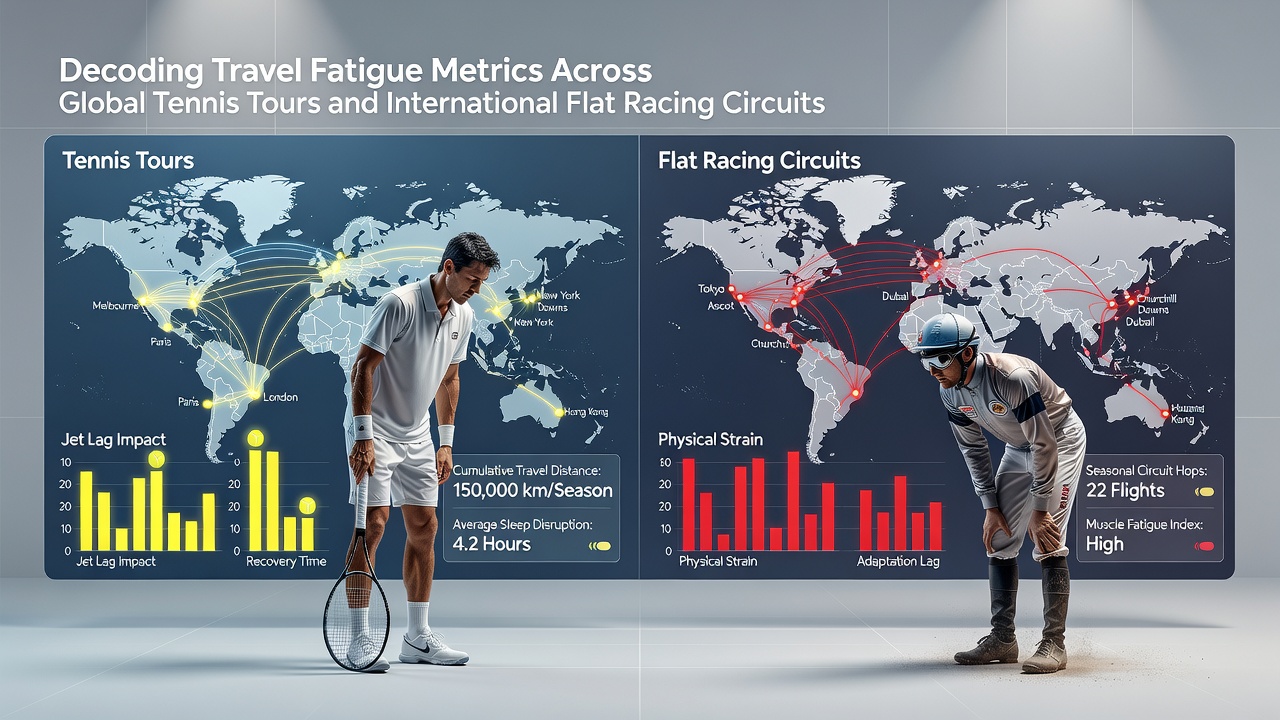
Cross-circuit comparisons reveal interesting parallels between species. Both tennis players and racehorses exhibit measurable drops in fine motor control and explosive power when circadian rhythms remain misaligned. A 2025 collaborative paper from the University of Guelph and the Racing Science Centre in Newmarket tracked 68 Thoroughbreds and 31 elite tennis players using wearable sensors. The study found overlapping patterns in recovery curves once total travel time and climate shift were controlled for.
Shared Measurement Tools and Emerging Standards
Organizations such as the International Federation of Horseracing Authorities and the International Tennis Federation have begun sharing anonymized datasets on travel-related performance variables. These exchanges allow analysts to test whether models developed for one sport transfer to the other. Early results suggest that a composite score incorporating sleep efficiency, hydration markers, and reaction time predicts next-day output with similar accuracy in both domains.
July 2026 data releases from several governing bodies are expected to include expanded tracking of short-haul versus long-haul effects within the same continent. Such granular information helps separate the impact of simple journey length from full circadian disruption. Teams and stables that integrate these metrics into scheduling software report fewer last-minute withdrawals linked to fatigue-related issues.
Practical Applications for Cross-Sport Analysis
Performance analysts now build comparative dashboards that align tennis match statistics with race sectional times. When a tennis player’s average rally length drops after a transatlantic flight, the same modeling framework flags comparable reductions in a horse’s final 400-meter split following equivalent travel. This approach enables identification of transferable resilience factors without relying on sport-specific assumptions.
Continued refinement of these metrics supports more precise planning for both calendars. Event organizers gain clearer windows for scheduling rest days, while medical and veterinary staff receive earlier alerts when an individual’s recovery trajectory deviates from established norms. The result is a growing body of objective, comparable data that spans two otherwise distinct athletic domains.
Conclusion
Objective measurement of travel fatigue continues to evolve through coordinated data collection across tennis and flat racing. Standardized indicators, shared research protocols, and scheduled updates in 2026 provide clearer pictures of how time-zone shifts and journey duration affect outcomes in each sport. Those working with the datasets gain practical tools for anticipating performance variability based on travel history alone.