Weather's Subtle Grip: How Wind, Rain, and Temperature Swings Reshape Value in Equine Races, Court Matches, and Field Events
Morgan Griffin · Jul 31, 2026
Weather's Subtle Grip: How Wind, Rain, and Temperature Swings Reshape Value in Equine Races, Court Matches, and Field Events
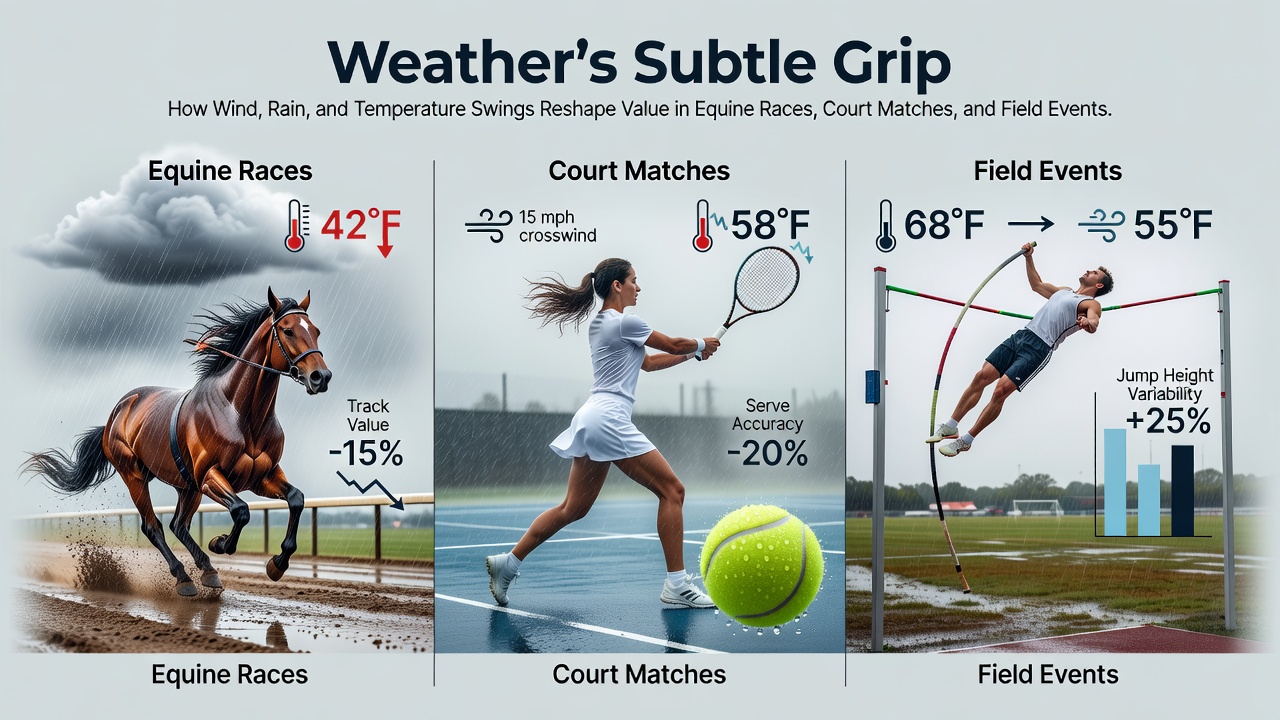
Wind, rain, and temperature fluctuations alter competitive conditions across equine races, court matches, and field events in measurable ways that shift performance metrics and betting lines. Observers note that these atmospheric variables interact with track surfaces, ball trajectories, and athlete endurance, creating patterns that data analysts track through historical records and real-time forecasts. Research from multiple racing jurisdictions shows that sustained winds above 15 kilometers per hour on straight sections of flat tracks correlate with slower overall times, particularly when horses encounter headwinds during the final furlongs.
Equine Racing Dynamics Under Variable Conditions
Rainfall modifies ground conditions by increasing moisture content in turf and dirt surfaces, which changes stride lengths and energy expenditure for different horse profiles. Studies compiled by Australian racing authorities indicate that soft ground following heavy precipitation favors stamina-oriented runners while reducing the advantage of speed-focused animals that perform better on firmer going. Temperature swings compound these effects because warmer conditions accelerate track drying rates, whereas cooler overnight temperatures preserve moisture levels into race day. Bettors who monitor Bureau of Meteorology precipitation totals and wind direction forecasts often identify discrepancies between official going reports and actual race outcomes during July 2026 meetings across regional circuits.
Crosswinds present additional variables on exposed tracks, where they can push horses off their intended lines during turns and alter the effectiveness of certain riding tactics. Data collected from North American tracks demonstrates that quarter-mile times increase by an average of 0.3 seconds when crosswind speeds exceed 20 kilometers per hour, an adjustment that oddsmakers incorporate gradually rather than immediately. Those analyzing sectional timing splits alongside meteorological readings locate value in horses whose past performances include exposure to similar wind vectors.
Court Match Adaptations and Environmental Factors
Tennis surfaces respond differently to weather elements, with clay courts absorbing moisture more readily than hard courts and thereby slowing ball speeds while increasing bounce heights. Wind affects serve placement and trajectory consistency, especially on outdoor venues where gusts disrupt toss timing and spin control. Temperature variations influence muscle elasticity and recovery intervals between points, with higher heat levels accelerating fatigue in longer matches according to physiological research conducted at European sports institutes. Court matches scheduled during periods of rapid barometric pressure changes have shown elevated rates of unforced errors in sets extending beyond two hours.
Precipitation delays introduce recovery variables because players must readjust movement patterns after interruptions, and historical match logs reveal that certain competitors maintain higher first-serve percentages following rain suspensions. Wind direction relative to baseline orientation further modulates rally lengths, with tailwinds extending points while headwinds compress them. Analysts cross-reference venue-specific weather archives with player statistics to isolate instances where line movements lag behind documented environmental impacts.
Field Event Performance and Atmospheric Influences
Field events such as throws and jumps register direct sensitivity to wind assistance rules, where legal tailwinds up to 2 meters per second can add measurable distance to recorded marks. Horizontal jumps and throws exhibit greater variance under shifting wind vectors than vertical events, because approach runups and release angles interact with air resistance in real time. Temperature affects implement grip and muscle readiness, with cooler conditions requiring extended warm-up periods that alter competition pacing. Data aggregated from international athletics meets shows that sudden temperature drops of 5 degrees Celsius or more coincide with reduced distances in discus and javelin events during afternoon sessions.
Rainfall softens approach surfaces in jumping events and changes rotational dynamics in throwing circles, leading to technique adjustments that favor athletes with prior experience in wet conditions. Wind patterns during field sessions often create localized advantages on certain runway orientations, and meet organizers publish anemometer readings that allow performance comparisons across different atmospheric windows. Those examining results from multiple venues note recurring patterns where wind-adjusted marks diverge from unadjusted projections used in initial odds compilation.
Integrated Patterns Across Disciplines
Combined datasets from racing, tennis, and athletics demonstrate that weather variables produce overlapping effects on energy systems and equipment behavior, yet each sport maintains distinct thresholds for meaningful performance shifts. July 2026 competitions across several continents provided fresh examples where rapid weather transitions coincided with late adjustments in market pricing. Cross-sport comparisons highlight that temperature and wind exert stronger influences on events lasting under two minutes, while precipitation impacts accumulate more noticeably in endurance formats. Organizations such as the National Oceanic and Atmospheric Administration supply granular forecast layers that support these comparative analyses when paired with official competition logs.
Conclusion
Atmospheric conditions continue to modify measurable outcomes in equine races, court matches, and field events through documented interactions with surfaces, trajectories, and physiological responses. Records maintained by meteorological agencies and sports governing bodies supply the raw inputs for identifying where performance baselines diverge from market expectations. Ongoing collection of weather-correlated results across jurisdictions supports refined modeling of these variables without reliance on subjective interpretation.